
Catoosa Police Blotter Status
Start with the Lookout Mountain Judicial Circuit's jail reports index. It links a Catoosa Daily Report. That link opens a 57-page PDF. Its first page reads "Jail Population Report," dated June 9, 2015. The old field headings still help. Use them only as a map. Treat the document as a stale artifact. It is not this week's Catoosa County police blotter.
For present custody, the sheriff-linked roster is the official fallback. It falls short as a multi-day arrest log. Released people drop off the list. Fort Oglethorpe and Ringgold police records, the sheriff's booking file, and later court records remain distinct sources. The arresting officer documents the incident, the jail logs booking and bond, and the court records the outcome.
That split is why no single page tells the whole story. A city report describes the event, while a jail entry captures booking, bond, and housing at one moment. The clerk's docket later shows arraignment, motions, pleas, or trial. A good multi-day search follows that chain without treating any one source as a substitute.
The Lookout Mountain Judicial Circuit's Catoosa information page offers court and calendar routes. That helps place an old booking in case context.
This is a court information source, not a current Catoosa arrest log or jail roster.
Read Catoosa Arrest Reports
Start from the newest official status and work backward. That keeps a stale archive entry from reading as current custody in Catoosa County.
- Set the date range. Write down the days you need and the likely agency. A multi-day range is the key distinction from Arrests Last 24 Hours.
- Check current custody. Search the Zuercher roster from the sheriff's Inmate Related page. Record the exact name, date, agency, and any booking number shown.
- Inspect source dates. If a PDF or article appears, find its publication date and internal report-run date. Do not rely on the URL or page title alone.
- Check story coverage carefully. Local and regional publishers select events. Their archives can supply leads but are not complete official logs.
- Request the older booking record. Use Catoosa GovQA for Sheriff's Office records, stating a narrow date range and the known identity details.
- Finish with court records. Match the booking to the correct Catoosa court case and read its disposition rather than assuming the original charge remained unchanged.
Catoosa Arrest Log Fields
The old report shows past Catoosa jail fields. Its columns do not bind the modern portal. Use it to shape a records request, and let the current record control.
| Historical field | How to use it |
|---|---|
| Inmate number and name | Identifiers for matching the person and requesting the correct booking file. |
| Arrest date and book date | Separate event and intake dates that can help define a multi-day search. |
| Bond and location | A status recorded when the report ran, not a promise of current custody. |
| Charge and offense level | Charges as then recorded, subject to later change in court. |
| Hold-for and arresting agency | Clues to which agency owns the incident or warrant record. |
| Attorney and first appearance | A bridge to court process, not a final disposition. |
| Photograph | No reviewed official page promises a photo in the current public roster. |
The old report's columns covered days in jail, housed status, property, physical date, sentence, and felony or misdemeanor flags. Labels change over time. A booking photo may exist without ever appearing online. Records can supply the sheet on request. No photo gallery appears here.
Ask for the "booking record" and give the full name, date range, agency, and any number. Request the photo only if the office keeps one, and ask for the legal basis behind any denial. Clear wording helps staff locate what already exists. It avoids asking them to build a new list.
Catoosa Weekend Posting Gaps
Nothing sourced in Catoosa County proves a weekend arrest surge, a Monday batch, a holiday delay, or a fixed posting time. No pattern holds. First appearance usually happens by weekday video. Weekend timing rests with the magistrate, and that schedule says nothing about when the roster updates. Booking, release, and posting are separate events.
A Friday-to-Monday search should span a date range and several channels. Check the current roster first. Save any booking identifiers. If a released person vanishes from the list, ask Records for those dates. The Catoosa County recent arrests hub maps the county, city, court, state, and federal custody channels.
Note: A Monday roster is a custody snapshot, not a complete list of every person arrested over the weekend.
Catoosa Booking Record Archives
Georgia sets minimum retention periods for local government files. The published schedules keep incarceration lists for one year. Jail registers must stay on hand ten years after the last entry. Jail booking records and inmate case files carry the same ten-year span, counted from release. Those are filing rules for agencies, though. They say nothing about what you can search online. And they never promise a booking photo stays viewable on the public Zuercher site for that whole stretch.
So start with the Sheriff's Records Division. Name the person, give the date, and ask which record series and adopted schedule apply. When a file is gone, staff can share the destruction or transfer details. GovQA serves as the central request channel for County government, Sheriff, and Courts. Custody still decides who answers. The sheriff holds jail booking material, a city police department holds its incident file, and the clerk holds the docket and outcome.
The old circuit PDF has real historical worth. It just cannot prove the circuit keeps every jail record. Georgia Archives can walk you through a schedule or a possible transfer. Neither replaces the live jail roster for who is in custody right now.
Broad requests invite confusion. Different series can sit with different custodians under different rules. An incarceration list, a jail register, a booking record, an inmate case file, a police incident report, or a court docket each follows its own path. Give a tight date range and a booking number when you can. If staff say a file was destroyed under an approved schedule, request the citation. Ask for any destruction or transfer record too. A blank search result never means the arrest never happened.
There is one more wrinkle. Georgia Archives keeps Open Records Act requests and correspondence for three years. Yet several jail record categories last longer. Agencies must follow those minimums. No rule forces a public search portal to keep the same material online. The full retention span does not apply to it.
Catoosa Crime News Blotters
News coverage in Catoosa County comes from a patchwork of publishers. The Georgia Gazette runs an independent crime and court index for the county. Aggregators RecentlyBooked and Arrests.org each keep county-local pages. CatWalkChatt and Northwest Georgia News carry regional police and fire leads. WDEF posts sheriff-tagged stories on no set schedule. None of these equals a government daily blotter. The RecentlyBooked Catoosa page shows what such an unofficial index typically looks like.
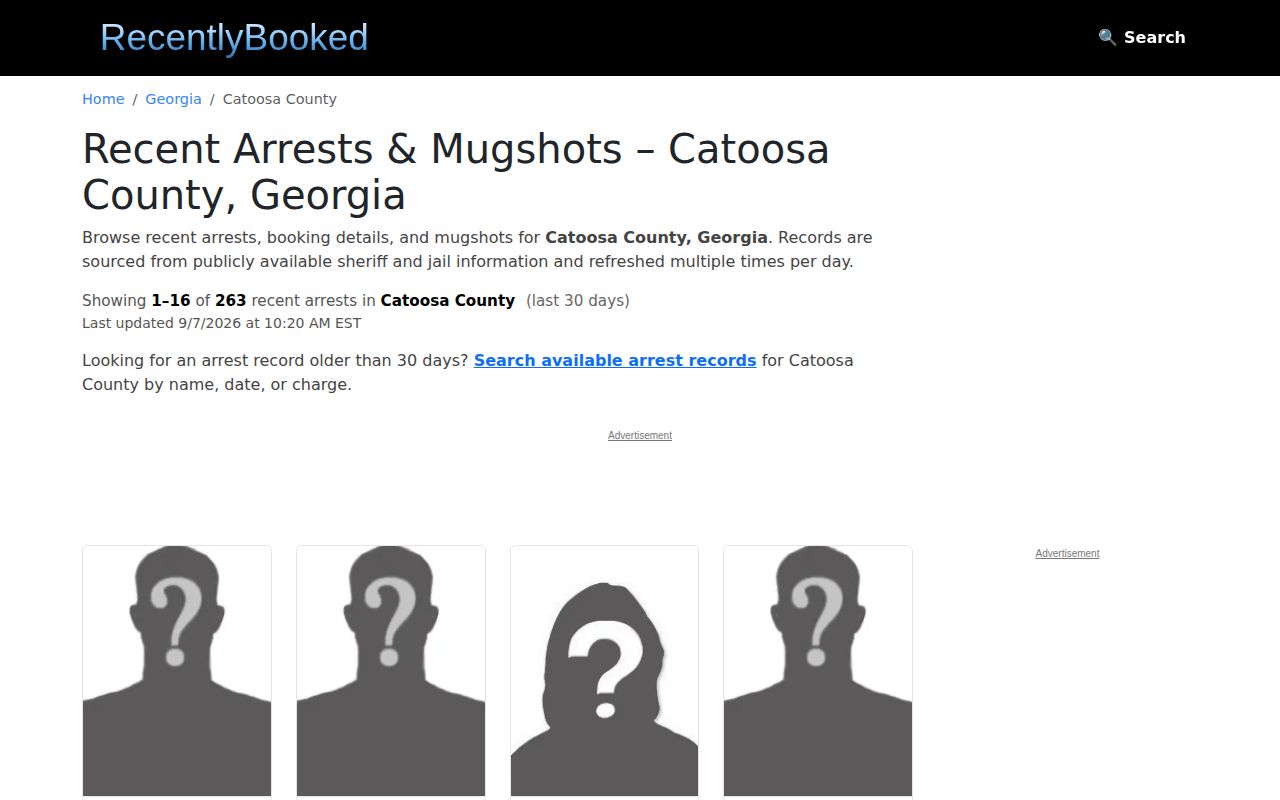
Editors pick which arrests become stories. Silence from a news site proves nothing about who was arrested. Aggregator entries lag behind real events. They linger after a person walks free. Some blend a fresh booking with older material. For custody, identity, and outcome, rely on the sheriff and the courts. Every booking photograph documents an arrest moment, nothing more.
Each publisher here works differently. RecentlyBooked posts its own update schedule and recent totals. Those figures are the publisher's claims, not Catoosa County statistics. Arrests.org provides archive controls and warns that its coverage is incomplete. Mugshots.com leans heavily toward older Catoosa years. The Georgia Gazette publishes periodic crime and court posts without promising any fixed interval. Any of them can hand you a lead. Not one can confirm a person is still in jail today.
Catoosa Charges Versus Outcomes
A blotter freezes one early moment in a case. After arrest, the booking charge can change course in many ways. It can be amended, dismissed, nolle prossed, or dead-docketed. It may be resolved by plea, or taken to trial. The final answer lives elsewhere.
For Superior and State Court, use the Lookout Mountain Judicial Circuit and the Catoosa clerk. Municipal arrests may land in the relevant city court instead. When two people share a name, be careful. Compare the case number, court, date, and outcome before drawing any conclusion. An old article, a booking image, or a jail line is never a verdict.